What Actually Drives Career Growth in Salesforce Roles
- Team Saltbox Mgmt

- Feb 9
- 2 min read
Updated: Feb 10
Some of the most important insights from this survey weren’t obvious going in. They emerged only when we compared patterns across charts and looked at how different factors interacted.
This post focuses on the findings that challenged assumptions and revealed clearer signals than expected.
English proficiency shows the strongest relationship to salary
No factor in this dataset correlates with compensation as strongly as English proficiency.
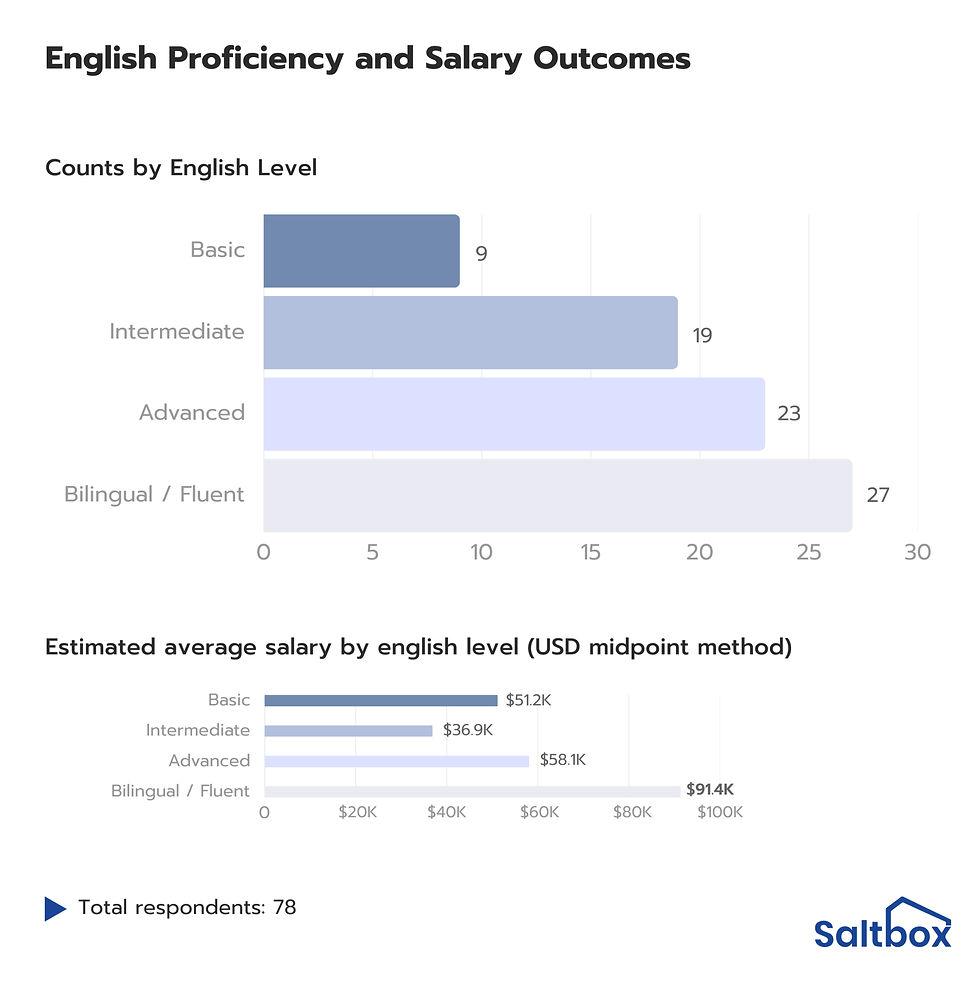
Using midpoint estimates for salary ranges:
Bilingual / Fluent respondents average approximately $91,400 USD
Advanced English averages around $58,100 USD
Basic English averages approximately $51,200 USD
Intermediate English averages just $36,900 USD
The gap between Intermediate and Bilingual respondents is larger than any other difference measured in the survey.
This was the strongest pattern in the entire dataset.
“Advanced” English does not unlock the same outcomes as bilingual fluency
One of the more unexpected findings is how close Basic and Advanced English salaries appear relative to Bilingual respondents.
While Advanced English indicates strong comprehension, it does not consistently translate into access to the highest-paying roles. The sharp compensation jump occurs only at bilingual or fluent levels.
This suggests that employers primarily reward English proficiency when it enables full participation in clientU global, client-facing, or leadership contexts.
Certifications do not offset language barriers
Even respondents with higher certification counts remain clustered in mid-range salary bands if English proficiency is limited.

Some professionals with multiple certifications still fall within the $35k–$65k range, while others with fewer certifications but stronger English skills appear in much higher bands.
This reinforces a surprising conclusion: certifications alone do not compensate for communication limitations in a global delivery market.
The market appears split into two talent economies
Taken together, the data suggests an implicit divide.
One group primarily serves domestic or regionally scoped roles
Another group operates in global, exportable roles where English is essential
These two paths coexist in the same ecosystem but are rewarded very differently. The divide is not defined by role titles or certifications. It is defined by access.
What this changes about the conversation
These findings suggest that career acceleration in Mexico and LATAM is less about accumulating credentials and more about expanding scope.
English proficiency functions less like a soft skill and more like a gateway. It determines which roles, clients, and responsibilities are accessible.
That doesn’t diminish the importance of technical ability or experience. It reframes how those skills are valued in practice.
Closing perspective
This series set out to ground conversations about Salesforce careers in real data rather than assumptions.
Some findings confirmed what we expected. Others forced a rethink.
Both are useful.
Understanding which signals matter most is the first step toward navigating a market that continues to evolve.
P.S. We’re continuing to invest in Salesforce talent across Mexico and LATAM. If you’d like to see open roles at Saltbox Mgmt, you can find them here.